


If you have ever been quoted for a construction job and seen line items for sharp sand, sandfill, or gravel without knowing what they actually are, this guide will clear that up.
Aggregate is one of the most important materials used in construction. It goes into foundations, driveways, drainage systems, and concrete mixes. Choosing the wrong type or ordering too little can stall a project or create problems that only become visible months later.
Here is a handy guide to the aggregate materials Adequip supplies across Trinidad and Tobago and what each one is used for.
What Aggregate Materials Are Most Commonly Used in Trinidad and Tobago?
The most commonly used aggregate materials in Trinidad and Tobago include crusher run, sharp sand, plastering sand, sandfill, and gravel. Each serves a different purpose, from concrete production and drainage to site preparation and backfilling. Choosing the right material depends on the requirements of your project and the conditions on-site.
What Does Aggregate Mean?
Aggregate is a broad term for granular material used in construction. It includes crushed stone, gravel, and sand produced from quarries or natural deposits. According to the Minerals Education Coalition, aggregates represent the largest category of mineral production worldwide by tonnage, excluding energy minerals. That gives you a sense of how central they are to construction at every scale.
In Trinidad and Tobago, the aggregate materials most commonly used on residential and commercial sites include sharp sand, plastering sand, sandfill, gravel, and crusher run.
| Material | Primary Use |
| Crusher Run | Compacted base layers and foundations |
| Sharp Sand | Concrete and mortar mixes |
| Plastering Sand | Rendering and finishing work |
| Sandfill | Site levelling and bulk fill |
| Gravel | Drainage and landscaping |
Crusher Run
Crusher run is a mixture of crushed stone and stone dust. It contains particles of different sizes, which is what makes it effective. When compacted, the smaller particles fill the gaps between the larger ones, creating a dense and stable base that can support heavy loads.
What it is used for:
- Driveways and access roads as a base layer
- Sub-base for concrete slabs and paved areas
- Foundation fill beneath buildings and structures
- Backfill in trenches where compaction is required
Crusher run is one of the most widely used aggregates for both residential and commercial work in Trinidad and Tobago. If you are building a driveway, laying a concrete slab, or filling in after an excavation, it is likely part of the material list.
Sharp Sand
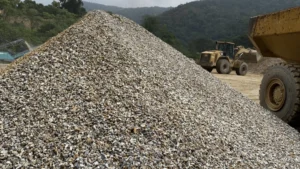
Sharp sand is a coarse, angular sand with a gritty texture. Unlike softer, finer sands, the angular shape of its particles means they lock together well, which makes it a strong choice for mixing into concrete and mortar. It is also used as a bedding material beneath paving where stability is important.
What it is used for:
- Concrete mixes for structural applications
- Mortar for blockwork and bricklaying where strength is required
- Bedding layer beneath paving slabs and outdoor tiles
- Drainage and filter layers where free-draining material is needed
Sharp sand is different from plastering sand. The two are sometimes confused, but they are not interchangeable. Sharp sand is coarser and better suited to structural and outdoor applications.
Plastering Sand
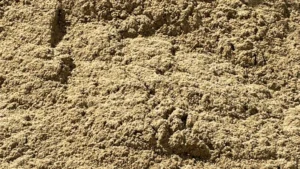
Plastering sand is a fine, smooth sand used for finishing work. Its smaller, more uniform particles produce a workable mix that spreads evenly and dries to a smooth surface. It is the right material when the finish matters, not just the strength.
What it is used for:
- Interior and exterior plastering and rendering
- Fine mortar for pointing and detailed masonry work
- Finishing coats on block and brick surfaces
Plastering sand should not be used as a structural aggregate or in concrete mixes. It is a finishing material, and its particle size makes it unsuitable for applications that require compaction or load-bearing capacity.
Sandfill
Sandfill is a general-purpose fill material used to raise ground levels, backfill excavations, and prepare sites for construction. It is not a refined or graded material in the way that sharp sand or plastering sand is. Its value is in volume and stability when used in the right context.
What it is used for:
- Backfilling excavations after pipe or utility work
- Raising and levelling ground ahead of construction
- General site fill where a compactable material is needed
- Sub-base preparation on larger sites
Sandfill is typically used where the final surface will be covered, either by concrete, paving, or topsoil. It is one of the more cost-effective materials for bulk fill requirements.
Gravel
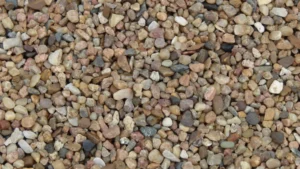
Gravel is a coarse aggregate material made up of stone particles larger than sand. It can be naturally rounded or angular depending on the source and grading. Because it is a free-draining material, it is well suited to drainage applications, but depending on the type and grading, it is also used in road bases, driveway construction, and other base layer applications.
What it is used for:
- Drainage layers beneath slabs and around foundations
- Road bases and driveway construction depending on grading
- Decorative landscaping and garden paths
- French drain and soakaway systems
- Driveway surfaces where a free-draining finish is preferred
Gravel is a common choice for drainage applications in Trinidad and Tobago, particularly in areas with heavy rainfall where water management around a building or site is important.
How Much Aggregate Do You Need?
This depends on the area being covered, the required depth, and the type of material. Your contractor or supplier can calculate the required tonnage once they know the dimensions of the area and the application.
A few practical points:
- Aggregate is typically sold and quoted by the tonne in Trinidad and Tobago.
- Coverage per tonne varies depending on the material, so confirm quantities with your supplier before ordering.
- For layered applications like a driveway, you may need more than one material type. Crusher run as a compacted base, for example, followed by gravel or a finishing layer on top.
- When in doubt, order slightly more than the calculated amount. Running short mid-project may require a second delivery, which can add cost and time.
Aggregate Supply and Delivery in Trinidad and Tobago
At Adequip, we supply sharp sand, plastering sand, sandfill, gravel, and crusher run for residential and commercial projects across Trinidad and Tobago. We also handle transportation and delivery directly to your site, which means you are not coordinating between a quarry and a separate haulage company.
If you are also planning excavation or backfill work alongside your material order, we can handle both. Many of our aggregate customers need an excavator or backhoe on site as part of the same job, and we can coordinate the equipment and the material supply together. Read our excavation services page to see how that works.
If you are unsure which material your project requires or how much to order, contact us and we will advise based on the scope of the work.
Get in touch online or call +1(868) 270-4300. We are available 24/7.