


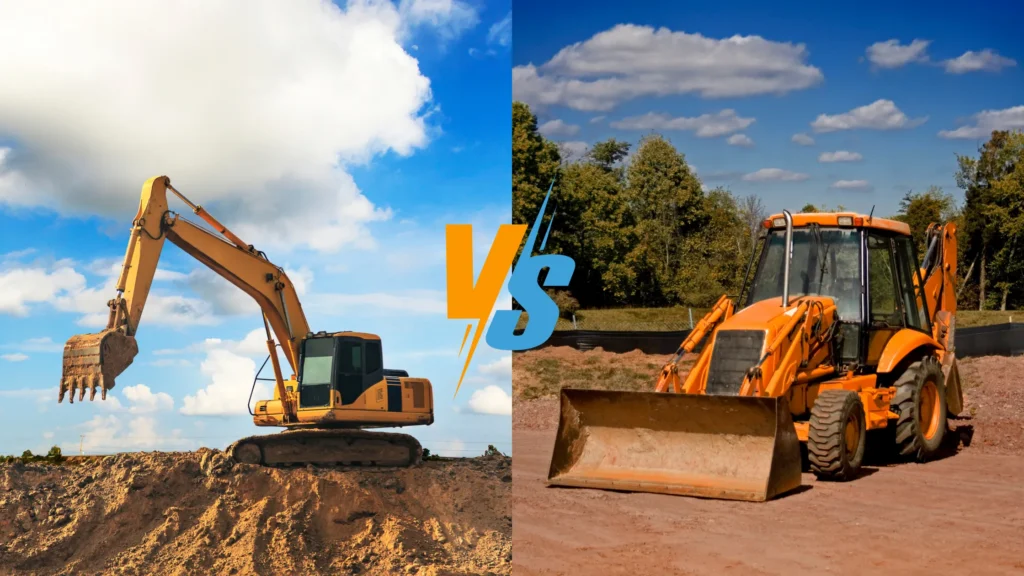
If you have ever called a contractor and been asked “Do you need an excavator or a backhoe?” without really knowing the difference, you are not alone. Although people often use the terms interchangeably, they are two different machines. Choosing the wrong one can slow your project down and cost more than necessary.
Here is a plain-English breakdown of what each machine does, which size suits your job, and which one makes the most sense for your budget and timeline.
What Is an Excavator?
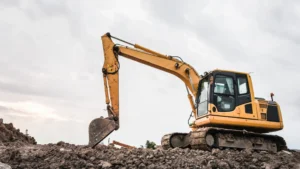
An excavator is a large digging machine mounted on tracks. The cab sits on a rotating platform that can swing a full 360 degrees, allowing the operator to dig, swing, and dump without moving the machine.
Excavators come in a range of sizes, and the size matters as much as the machine type. Here is how the models in our fleet map to common job types in Trinidad and Tobago:
| Model | Weight Class | Best For |
|---|---|---|
| Cat 302 | Mini (approximately 2.3 tonne) | Very tight access sites, narrow driveways, light residential digging |
| Cat 303 | Mini (approximately 3.5 tonne) | Residential lots, pools, tight-access sites, Maraval-style properties with narrow driveways |
| Cat 313 / 316 | Mid-range | Standard house foundations, moderate land clearing, 3-bedroom builds |
| Cat 320 | Large (20 tonne+) | Large commercial earthmoving, deep drainage infrastructure, major site prep |
Larger excavators dig deeper and move more material per pass than a backhoe loader. Mini excavators such as the Cat 302 and 303 are more compact and may have shallower dig depths than a standard backhoe, but they excel in access and precision on tight residential sites.
Best for:
- Deep foundation excavation
- Large-scale land clearing
- Demolition of concrete structures
- Bulk earthmoving on commercial sites
- Trenching for drainage or utilities across long distances
What Is a Backhoe Loader?
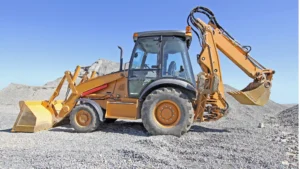
A backhoe loader looks more like a tractor. It has a digging arm at the back and a loader bucket at the front. It is smaller and more versatile than an excavator, making it well suited for medium-scale construction, loading jobs, and site work where you need to switch between tasks quickly.
Because it runs on wheels rather than tracks, a backhoe loader can travel on roads and paved surfaces more easily than a tracked machine. That matters on a finished residential street where you need to trench for a utility line without tearing up the road with tracks. It also makes it easier to move between different areas of a site and, in many cases, travel short distances between nearby jobs.
For a two or three-day job involving both digging and loading, a backhoe loader is often the more cost-effective rental choice. One machine, one mobilisation cost, one day rate.
Best for:
- Digging utility trenches in tighter spaces
- Loading and moving material around a site
- Mixed-use jobs where you need to both dig and load
- Smaller residential excavation
- Sites with limited access or finished surfaces nearby
The Key Differences at a Glance
Size and power: Larger excavators are significantly more powerful than backhoe loaders and outperform them in heavy-duty digging, bulk earthmoving, and demolition. Mini excavators such as the Cat 302 are considerably lighter than a standard backhoe loader and are chosen for access and precision rather than raw power.
Swing range: Backhoe loaders have a swing arc of 180 degrees, while excavators can rotate a full 360 degrees. The full rotation allows excavators to dig and dump without constantly repositioning the machine, making them more efficient for larger excavation projects.
Versatility: Backhoe loaders combine a front loader and rear excavator arm in one machine, making them well suited to jobs that involve both digging and material handling without switching equipment.
Mobility: Backhoe loaders move on wheels and can travel short distances under their own power. Excavators move on tracks and generally need to be transported on a low loader between sites.
Dig depth: Standard backhoe loaders typically dig to depths of 4.3 to 4.4 metres depending on the model and stick configuration. Mini excavators such as the Cat 302 and 303 have shallower dig depths of approximately 2.57 and 2.95 metres respectively, making them better suited to access-constrained sites than deep excavation. Mid-range and large excavators dig significantly deeper than any backhoe and are the right choice for demanding ground conditions and deep drainage work.
Which One Do You Need for Your Project in Trinidad?
Here is how common jobs in Trinidad and Tobago map to the right machine and size.
Choose an excavator if:
- You are digging a pool or working on a tight residential property. The Cat 303 suits most residential lots, while the Cat 302 is the right call for the tightest access sites such as narrow Maraval driveways.
- You are excavating a foundation for a 3-bedroom house. A Cat 313 or 316 handles the depth and volume efficiently.
- You need deep trench work for drainage infrastructure on a large site. A Cat 320 is the right call.
- You are clearing a significant area of land before a commercial development.
- Your job involves demolishing a concrete or masonry structure.
Choose a backhoe loader if:
- You need to dig a service trench along a finished residential street and load the spoil at the same time. Wheels, not tracks, protect the road surface.
- The job runs two to three days and involves both digging and loading. One machine at one day rate is more cost-effective than hiring two.
- Your site is tight or has road access constraints.
- You are working on a smaller residential job where a large excavator would be more machine than the job requires.
Not Sure Which Size Suits Your Job?
Give us a call. We would rather you have the right machine than the biggest one. When you contact Adequip, we will ask about your site, the scope of the work, and what you are trying to achieve. From that conversation, we can match you to the right model without overspecifying.
If you are also thinking about how to prepare your site before the equipment arrives, our site preparation guide covers exactly that.
Get the Right Machine for Your Job in Trinidad
At Adequip, our excavator fleet includes the Cat 302, 303, 313, 316, and 320, covering everything from tight residential access to large commercial earthmoving. We also operate backhoe loaders for residential and light commercial work.
Our experienced operators work efficiently and safely across a wide range of project types. We serve clients across Trinidad and Tobago, from homeowners clearing residential lots to contractors managing full-scale commercial developments.
Call us at +1(868) 270-4300 or get in touch online to discuss your project. Our team is available 24/7.